Duplicate data as a hidden cost across the public sector
When an office retypes information about its services into a content management system of its own, a copy of the data comes into being. That copy will be accurate at first. Then the legislation changes and the copy falls behind. Or the platform changes and the copy has to be migrated. Or the person responsible for keeping it in sync leaves and nobody else treats it as their job.
This problem is not an exception. It is the standard life cycle of data in the public sector whenever nobody asks where the single source of truth should be.
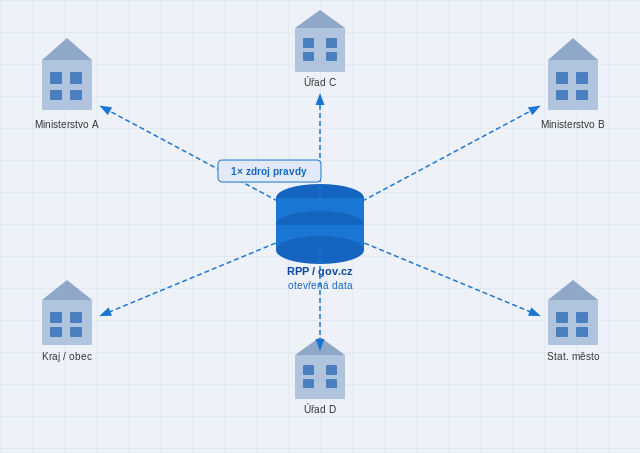
Yet the state does hold legally binding data about agendas and services. It maintains it in the Register of Rights and Obligations and publishes it as open data. The data is legally binding, regularly updated, and available in a structured form. Even so, offices, regions, and public institutions routinely retype it into local systems, creating an ecosystem of copies, each of which ages at its own pace.
A presentation layer on top of shared data is not a compromise, it is the right architecture
The approach used in the Ministry of the Environment service catalog follows a simple principle: an office is responsible for presenting its services, not for maintaining the data that already exists about them. That responsibility stays where it belongs, at the central level of the state.
The catalog automatically pulls the relevant subset from the open data of the state, only those agendas and services where the ministry is identified as the provider. It processes this dataset, indexes it, and shows it to visitors in a context that makes sense to them.
The result is an architecture with clearly divided responsibilities. The state guarantees that the data is correct and current. The office provides a clear, contextual presentation of it. The editor of the website does not have to worry about keeping up with the legislation, because that happens automatically.
Scalability, the argument missing from technical discussions
One catalog at one ministry demonstrates the principle. The real value of the approach shows up once more institutions adopt it.
The Czech Republic has fourteen regions, six cities with special status, and dozens of central government bodies. Today each of them handles the presentation of its services in its own way, with varying degrees of accuracy, varying structures, and varying maintenance costs. The source data for all of them exists in one place.
The model of the ministry catalog is transferable without a fundamental change of architecture. Filtering by public authority and adapting the user interface are relatively small changes compared with building an entire data infrastructure from scratch. The investment in a similar solution therefore does not start again with every new deployment: both the principle and part of the technical foundation are shared.
Feedback that improves the whole infrastructure
There is one more effect that does not appear in technical specifications: the more institutions rely on central open data as their primary source, the stronger the pressure on its quality.
Today the open data of the RPP is seen mainly as a transparency tool, a way of publishing information for public scrutiny. That is a legitimate purpose, but a limited one. If the same data served as infrastructure for dozens of public authority websites, it would become operationally critical. An error in the RPP would show up immediately in what the public sees. The motivation to keep it correct and complete would be an order of magnitude higher.
A positive loop forms: the quality of the data increases the value of the applications, and the value of the applications increases the pressure on the quality of the data.
What it takes in practice
The strategic choice to share rather than copy is not unconditional. It requires the central data to be sufficiently structured, current, and technically accessible. It requires offices to have either the capability or a partner able to build and connect the presentation layer. And it requires public sector web projects to ask this question explicitly, instead of automatically assuming that a local copy of the data will be created.
The Ministry of the Environment catalog shows that it can be done, that it is sustainable to run, and that the result, for the public and for the office alike, is better than the alternative.
Series: Ministry of the Environment service catalog
The specific benefits of the project for the ministry and for the public are described in the case study of the Ministry of the Environment service catalog.
The technical principles of the data architecture, synchronization from open data and the modeling of relationships between agendas and public authorities, are described in the methodological article The state already has the data about its services. What remains is to make it clear.