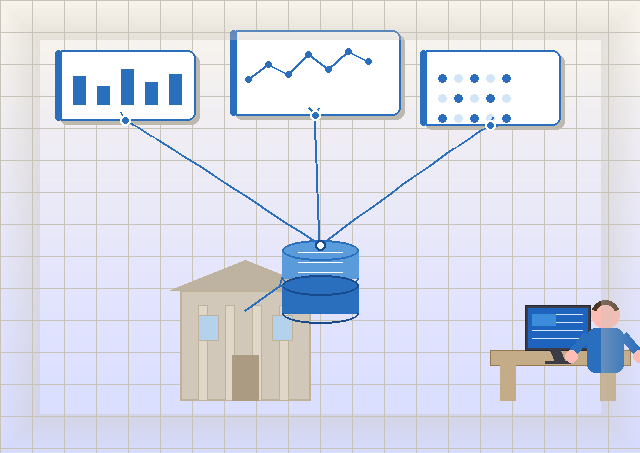
The Ministry of the Environment administers more than a hundred agendas and hundreds of related services. Anyone who wanted to know how to apply for an exemption from a tree felling ban, which subsidies applied to their situation, or how to report environmental damage correctly had to look for the information across portals, legislation, and different parts of the website. Macron Software changed that, but not by rewriting the data or storing it again somewhere new.
A problem that did not have to be solved with technology, although technology made an elegant solution possible
The brief was not to build a database of the services of the ministry. The state already has that database: the Register of Rights and Obligations (RPP) and the central gov.cz portal hold, as open data, every agenda and service that public authorities provide.
The problem was that this data is neither easy to reach nor easy to understand from the point of view of an ordinary visitor to the website of the ministry. It appears in the general context of the whole state rather than in the context of one particular department.
The brief for Macron Software was therefore to build a clear catalog of the services of the ministry that works automatically with official government data and does not require anyone to retype it.
What the catalog offers the public
The Ministry of the Environment service catalog is available directly on the website of the ministry. It gives an overview of every service the ministry is bound to provide as a public authority, whether as the provider or as the body that registers the agenda.
The catalog can be searched and filtered:
- by target group, that is whether the service is intended for the public, for businesses, or for non-profit organizations,
- by how it is handled, with the option to show only services available fully online,
- by topic, for example air protection, water management, subsidies, or waste management.
The result matches the visual standard of modern government: the catalog follows the GOV Design System, which keeps it consistent with the other public sector portals.
What the catalog brings the office
A common risk in public sector web projects is the shadow database, a situation where information about services exists both in the central registers and in the content management system of the website, and both have to be kept in sync. One legislative change is enough for the content on the website to fall behind reality.
The Ministry of the Environment catalog avoids that problem. It does not work with an editorial copy of the data but with an automatically updated data model synchronized from the open data of the state. If the parameters of a service change in the RPP, the change reaches the catalog without an editor touching it.
The result is a solution that is cheap to run, does not burden the team at the ministry, and at the same time guarantees alignment with the current state of the legislation and the registers.
The project as inspiration for other ministries and regions
The service catalog was designed as a repeatable model. The same approach, drawing on the open data of the state rather than building a parallel database, can be applied by any public authority.
Every ministry, region, or city that wants to offer its visitors an overview of the relevant services can build on the same foundations. The key is to identify the authority correctly in the dataset and to adapt the filtering and the presentation to the needs of the organization.
Exactly how the data architecture of the catalog works, and why modeling the relationships between agendas, services, and public authorities was the key decision, is described in the technical article A context layer on top of central government data.